
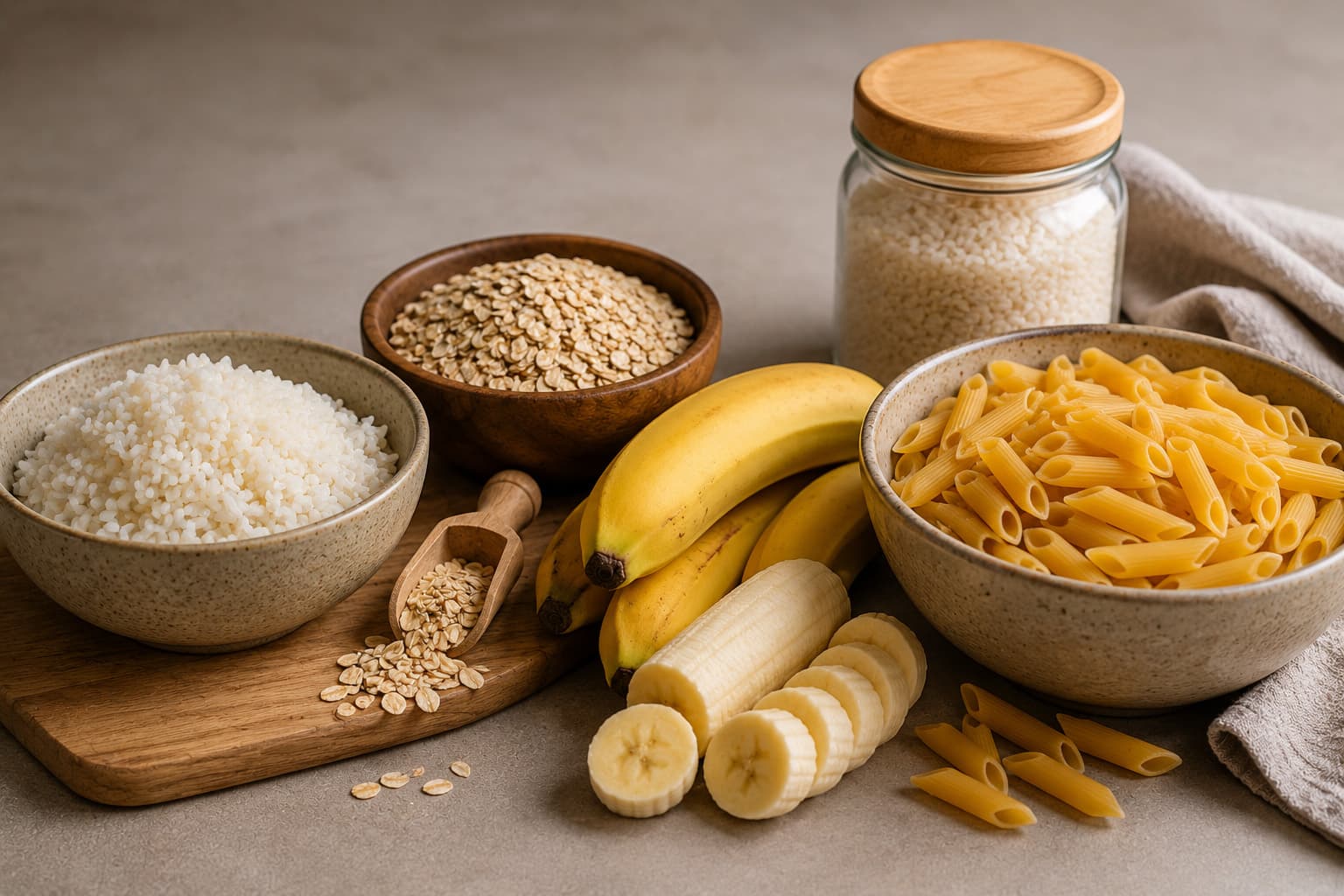
How many carbs should you eat before a workout?
The direct answer:
- 2–3 hours before: 1–2 g/kg of complex carbs + 0.3 g/kg protein
- 30–60 minutes before: 0.5–1 g/kg simple carbs, no fat
- 10–15 minutes before (if needed): 20–30 g high glycemic index carbs
Example for a 75 kg person:
- 2–3 hours before: 100 g brown rice (dry) + 80 g chicken → ~75–150 g carbs + ~22 g protein
- 30 min before: medium banana → ~27 g carbs ✓
Pre-workout carbs aren't an extra — they're the fuel that determines how much intensity you can sustain during the session. Without available glycogen, strength drops after the first few sets and endurance runs out earlier than expected.
In this guide you'll find:
- the exact carb dose per kg, per time window and by sport type
- which type of carbohydrate to choose and when glycemic index matters
- what to avoid in the hours before training
- real examples for different profiles and sports
All data is based on the Nutryon engine, designed to generate nutrition plans with optimized timing.
Pre-Workout Carbs: Quick Answer
| Window | Carb dose | Type | Notes |
|---|---|---|---|
| 3–4 hours before | 2–3 g/kg | Complex | Main meal |
| 2–3 hours before | 1–2 g/kg | Complex | Pre-workout meal |
| 60–90 min before | 1–1.5 g/kg | Mixed | Light snack |
| 30–60 min before | 0.5–1 g/kg | Simple | Quick boost |
| 10–15 min before | 20–30 g | High GI | Only if needed |
| Intra-workout | 30–60 g/hour | Simple | Only for sessions >90 min |
Why Glycogen Is the Primary Fuel
Muscle glycogen is the preferred energy source for any moderate-to-high intensity activity. Understanding why carbs matter pre-workout requires understanding how the body uses energy during exercise.
In lactic sports (weightlifting, sprints, combat sports, HIIT):
- Glycogen is the almost exclusive energy substrate
- Without glycogen, muscular power drops drastically after the first sets
- There's no metabolic alternative for high-intensity efforts
In aerobic sports (running, cycling, swimming):
- Glycogen regulates energy pacing in the first hours
- When glycogen runs out, the body switches to lipid metabolism — which is slower
- Speed and intensity inevitably drop (the so-called "bonking" or "hitting the wall")
The practical difference: A weightlifter who trains with low glycogen stores completes the first exercise but progressively loses intensity. A runner who starts with low glycogen inevitably slows down after 60–80 minutes of moderate-high pace running.
In summary
- Glycogen = fuel for both lactic and aerobic sports
- There's no substitute for high-intensity efforts
- Pre-workout carbs determine glycogen availability during the session
The Exact Dose: Formula by Weight and Window
2–3 hours before — main meal
Formula: weight (kg) × 1–2 g = carbs to consume
| Weight | Minimum dose | Target dose |
|---|---|---|
| 55 kg | 55 g | 110 g |
| 65 kg | 65 g | 130 g |
| 75 kg | 75 g | 150 g |
| 85 kg | 85 g | 170 g |
This is the main pre-workout meal. Combine complex carbs with moderate protein and limited fat.
30–60 minutes before — quick snack
Formula: weight (kg) × 0.5–1 g = simple carbs
| Weight | Indicative dose |
|---|---|
| 55 kg | 27–55 g |
| 65 kg | 32–65 g |
| 75 kg | 37–75 g |
| 85 kg | 42–85 g |
Source: easily digestible simple carbohydrates. No fat, no high fiber.
Calculated example — Runner 70 kg, 6pm training
-
3pm — Pre-workout lunch (3 hours before): 90 g whole wheat pasta (dry) + 120 g tuna + cherry tomatoes + 8 g olive oil → 540 kcal · 35 g P · 78 g C · 12 g F ✓
-
5pm — Quick snack (1 hour before): Medium banana + 200 ml fruit juice → 190 kcal · 1 g P · 44 g C · 0 g F ✓
-
Total pre-workout carbs: 122 g = adequate for a 70 kg runner ✓
Glycemic Index: When It Matters and When It Doesn't
The glycemic index (GI) measures how quickly a food raises blood sugar. In sports nutrition it only matters in relation to the time window.
| Window | Recommended GI | Reason |
|---|---|---|
| 3–4 hours before | Low–Medium | Gradual release = stable glycogen during session |
| 2–3 hours before | Medium | Balance between availability and stability |
| 30–60 min before | Medium–High | Rapid availability for the imminent session |
| 10–15 min before | High | Immediate fuel for the session |
| Intra-workout | High | Maximum absorption speed |
Foods by GI range:
| Low–medium GI (away from training) | Medium–high GI (close to training) |
|---|---|
| Brown rice, whole wheat pasta | White rice, white bread |
| Oats, quinoa | Ripe banana, grapes |
| Sweet potatoes | Fruit juice, honey |
| Legumes | Energy gels, dates |
In summary
- Low GI → main meals 2–4 hours before
- High GI → snack 30–60 minutes before
- For sessions >90 min: high GI sources during (gels, dates, banana)
How It Changes by Sport Type
Strength sports and hypertrophy (gym, crossfit, weightlifting)
Priority: muscle glycogen available for lactic efforts Pre-workout carbs: 4–6 g/kg/day with focus on meals close to the session
- 2–3 hours before: 1–2 g/kg complex carbs + 0.3 g/kg protein
- 30–60 min before: 0.5 g/kg simple carbs
- Intra: not needed for sessions < 60 min
Example — Male 80 kg, gym, strength:
- Pre 2h: 100 g white rice + 120 g chicken breast → 76 g C + 30 g P
- Pre 30 min: banana + coffee → 27 g C
Endurance (running, cycling, swimming >60 min)
Priority: maximize glycogen stores for prolonged sessions Pre-workout carbs: 6–8 g/kg/day with increase in 24h pre-race
- 3–4 hours before: 2–3 g/kg complex carbs
- 30–60 min before: 1–1.5 g/kg simple carbs
- Intra: 30–60 g/hour for sessions >90 min
Example — Female 60 kg, 90-minute run:
- Pre 3h: 80 g pasta + 100 g tuna → 68 g C + 24 g P
- Pre 1h: 100 g Greek yogurt + 10 g honey + banana → 42 g C + 9 g P
- Intra: 1 energy gel + water every 45 min
Intermittent sports (soccer, basketball, tennis)
Priority: full glycogen stores for repeated sprints and direction changes Pre-workout carbs: 5–7 g/kg/day, similar to endurance
- 3 hours before: main meal rich in complex carbs
- 1 hour before: light snack with simple carbs
- During the game: 30–45 g/hour carbs (isotonic drink + gel)
What to Avoid in the Hours Before Training
| Avoid | Reason | Critical window |
|---|---|---|
| High fat (>20 g) | Slows gastric emptying | In the 2 hours before |
| High fiber (>10 g per meal) | Can cause bloating and cramps | In the 2 hours before |
| Large meals | Slow digestion, reduce performance | In the hour before |
| Excess fructose | Slow absorption, risk of gastric discomfort | In the 60 min before |
| Alcohol | Compromises carbohydrate metabolism | 24 hours before for athletes |
Watch out for foods commonly considered "healthy" but problematic pre-workout:
- Large salads → high fiber
- Generous portions of avocado → high fat
- High-fiber whole grains → slow digestion
- Smoothies with whole milk + peanut butter → gastric slowing
In summary
- 1 hour before training: only simple carbs, no fat, no high fiber
- 2–3 hours before: complex carbs with protein, limited fat
- Avoid pure fructose close to the session (apples, pear juice)
Carb Loading: Only for Specific Events
Carb loading increases glycogen stores beyond normal levels. It makes sense in specific contexts.
When it makes sense:
- Endurance events >90 minutes (marathon, triathlon, long-distance cycling)
- Team sports with 2+ games in 48–72 hours
- Knockout competitions with back-to-back days
When it does NOT make sense:
- Regular gym workouts
- 45–60 minute sessions
- Recreational activity
Basic protocol:
- 48–72 hours before the event: carbs at 8–10 g/kg/day
- Reduce training (tapering)
- Expect body weight increase of +1–2 kg (water retention from glycogen, not fat)
In summary
- Carb loading = for long or multi-day endurance events
- Not needed for everyday gym sessions
- Expect +1–2 kg body weight (glycogen water retention, not fat)
What the Research Says About Pre-Workout Carbs
- ISSN literature recommends 1–4 g/kg carbohydrates in the 1–4 hours pre-workout to maximize available glycogen
- Studies on strength sports show that maximal strength performance and total volume are significantly higher with full glycogen compared to reduced glycogen conditions
- Research on carbohydrate loading (Coyle et al., 1986 and recent confirmations) shows that increasing carbs to 8–10 g/kg in the 48 hours pre-race is associated with better performance in endurance disciplines
- Meta-analyses on glycemic index and athletic performance show that a low GI 2–3 hours before is associated with more stable blood glucose during the session compared to high GI sources in the same time interval
Frequently Asked Questions About Pre-Workout Carbs
Can I train without pre-workout carbs?
For light aerobic sessions (< 60% VO2max) yes. For strength or high-intensity sessions, performance drops significantly without available glycogen. Fasted training works for metabolic adaptation, not for maximizing performance.
White rice or brown rice before training?
It depends on the time window. White rice → 30–60 minutes before (digests more quickly). Brown rice → 2–3 hours before (more gradual and stable release).
Is fruit good before a workout?
It depends on the type. Banana (fructose + glucose + potassium) → excellent 30–60 minutes before. Apple and pear (predominantly fructose) → less suitable in the close window, because fructose absorbs more slowly and can cause gastric discomfort.
How many carbs is too many pre-workout?
More than 2 g/kg in a single serving 30–60 minutes before can slow digestion and cause discomfort. Distribution across multiple moments (main meal + light snack) is more effective than one large amount.
Do pre-workout carbs cause fat gain?
No. Pre-workout carbs are used as fuel during the session. The issue isn't "when" but "how much in total" in the context of daily calorie intake.
Optimize Your Pre-Workout Carbs with Nutryon
Manually calculating carbs for each time window, each sport type and each day of the week is complex. Most people use generic values — or improvise based on hunger.
Nutryon automatically adapts:
- pre and post-workout carb amounts to your sport and intensity
- meal timing to your actual workout schedule
- daily distribution to your goal (performance, muscle gain, fat loss)
→ Enter your data and get a plan with carbs already optimized for your session.
Time required: less than 2 minutes.