
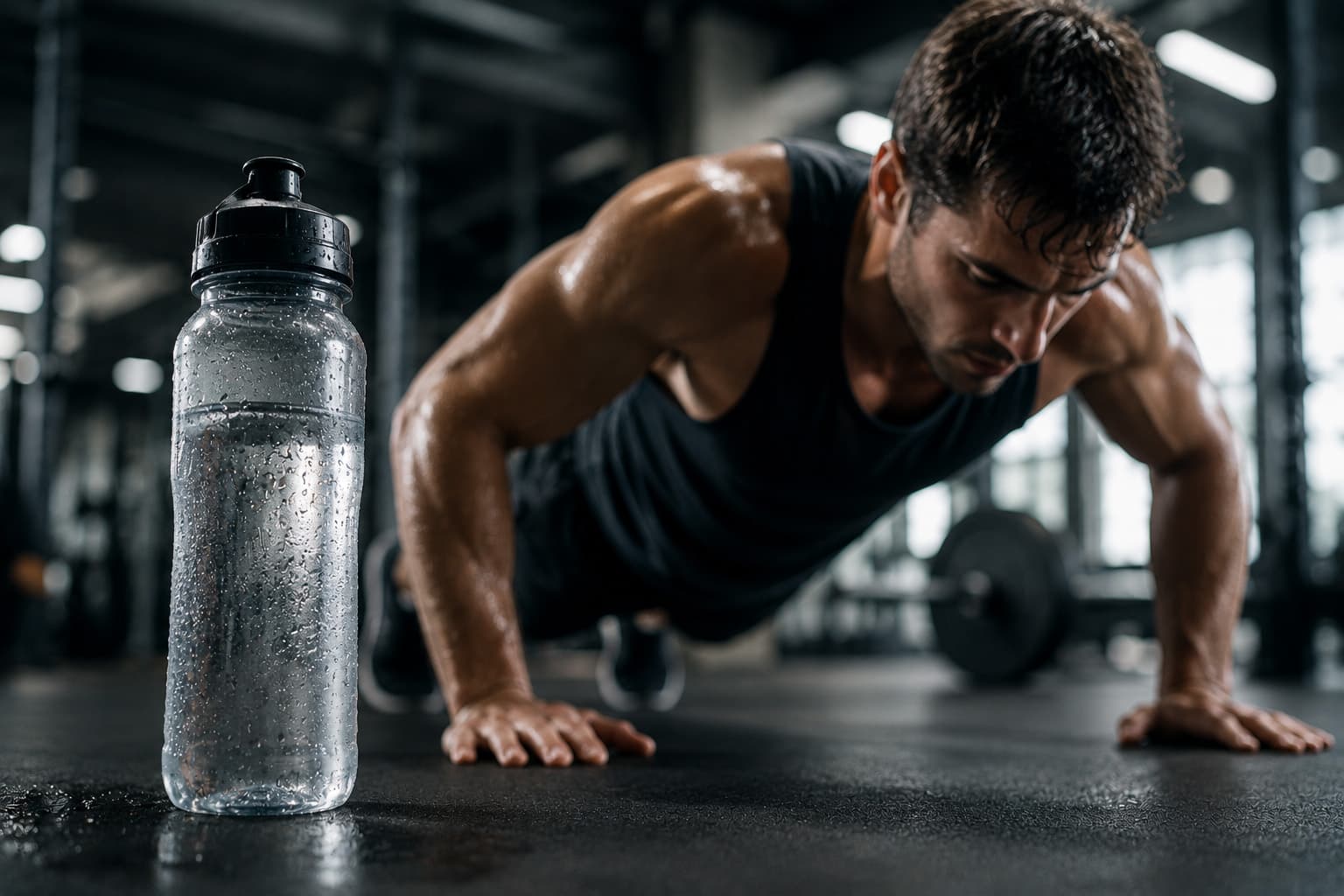
How much water should you drink when you train?
The direct answer:
- 2 hours before: 500 ml
- 30 minutes before: 200–300 ml
- During: 150–250 ml every 15–20 minutes
- After: 1.5 L for every kg lost during the session
Example for a 75 kg person losing ~1 kg of sweat in 60 minutes of intense gym training:
- Pre: 500 ml + 200 ml = 700 ml total
- During: ~500–750 ml (every 15–20 min)
- Post: 1.5 L to fully replenish
Hydration is the most easily overlooked performance factor — and one of the most easily improved. A 2% loss of body weight in water measurably reduces athletic performance. For a 75 kg person that's just 1.5 kg of sweat.
In this guide you'll find:
- exact water doses for every moment of the session
- when electrolytes become necessary (and when they're not)
- how to calculate your personal sweat loss
- differences between indoor and outdoor sports
- practical signals to tell if you're dehydrated
All data is based on ACSM guidelines and international sports literature, integrated into the Nutryon system.
Hydration for Athletes: Quick Answer
| Moment | Amount | Notes |
|---|---|---|
| 2 hours before | 500 ml | Stabilize pre-session hydration |
| 30–60 min before | 200–300 ml | Final top-up |
| During (every 15–20 min) | 150–250 ml | Adapt to intensity and sweat rate |
| Within 2h after | 1.5 × kg lost | Complete replenishment |
| Throughout the day | 35 ml/kg body weight | Daily baseline |
Why Dehydration Compromises Performance
The 2% rule is one of the most established findings in exercise physiology.
Effects of dehydration by level:
| Water weight loss | Performance effects |
|---|---|
| 1% (0.75 kg for 75 kg) | Increased perceived exertion, reduced concentration |
| 2% (1.5 kg for 75 kg) | −10–20% aerobic performance, strength decrease |
| 3% (2.25 kg for 75 kg) | Muscle cramps, nausea, cognitive difficulties |
| 4–5% (3–3.75 kg) | Heat stroke risk, severely compromised performance |
Most amateur athletes finish a session with a 1–2% loss without having perceived it as such. Habituation to the sensation of thirst is one of the main reasons.
The physiological mechanism:
- Less water in plasma → more viscous blood → heart works harder for the same output
- Less available plasma → less oxygen transported to muscles
- Higher core temperature → early activation of cooling mechanisms → performance drop
In summary
- −2% body weight in water = aerobic performance reduced by 10–20%
- Thirst arrives after actual dehydration has already begun
- Hydrate on a structured schedule, not "when you're thirsty"
Before Training: How to Hydrate Properly
Pre-workout hydration schedule:
| Window | Amount | Goal |
|---|---|---|
| 2 hours before | 500 ml | Hydration stabilization |
| 30–60 min before | 200–300 ml | Final pre-session top-up |
| 5–10 min before | 150 ml (optional) | Only if feeling thirsty |
How to know if you're well hydrated before training: Urine color is the most practical and reliable indicator.
| Urine color | Hydration status |
|---|---|
| Transparent/clear | Over-hydrated (too much water) |
| Light yellow (straw) | ✓ Optimal hydration |
| Medium yellow | Mild dehydration — drink |
| Dark yellow/orange | Significant dehydration — hydrate before training |
| Brown | Severe dehydration — don't train |
Goal: arrive at training with light yellow urine.
In summary
- Don't drink large amounts in the hour before — distribute over 2 hours
- Light yellow urine = optimal hydration
- Dark urine: add 500 ml in the 2 hours pre-session
During Training: How Much to Drink and How
Basic rule: 150–250 ml every 15–20 minutes, adapted to intensity and temperature.
Schedule by session duration:
| Duration | Recommended total | Frequency |
|---|---|---|
| < 30 minutes | 200–300 ml | End of session |
| 30–60 minutes | 400–600 ml | Every 20–25 min |
| 60–90 minutes | 600–1,000 ml | Every 15–20 min |
| >90 minutes | >1,000 ml + electrolytes | Every 15 min |
Adjustments for environment:
| Condition | Adjustment |
|---|---|
| Indoor gym air-conditioned (20°C) | Standard base |
| Indoor hot gym (>25°C) | +200–300 ml/hour |
| Outdoor summer (>28°C) | +300–500 ml/hour |
| High outdoor humidity | +200–300 ml/hour (sweating without evaporation) |
| Winter outdoor sports | −100–200 ml/hour (but don't eliminate) |
Attention to water sports: you sweat in the pool too. The sensation of coolness is misleading — the sweat rate is similar to moderate-pace running.
In summary
- 150–250 ml every 15–20 min as baseline
- Increase in hot or humid conditions
- In water sports: hydrate anyway, sweating still occurs
After Training: Complete Replenishment
Nutryon formula for fluid recovery:
Water to replenish (liters) = kg lost during session × 1.5
How to measure kg lost:
- Weigh yourself before training (no clothes, post-toilet)
- Weigh yourself after training (same conditions, without replenishing water during)
- Difference = kg lost primarily in sweat
Example:
- Pre-workout weight: 78.0 kg
- Post-workout weight: 76.8 kg
- Difference: 1.2 kg
- Water to replenish: 1.2 × 1.5 = 1.8 L in the following 2–4 hours
Don't drink it all at once — distribute over 2–4 hours.
Post-workout timing:
| Window | Amount |
|---|---|
| Within 30 min | 500 ml |
| 30–90 min | 500 ml |
| 2–4 hours after | Remainder (fractioned) |
In summary
- Formula: kg lost × 1.5 = liters to replenish
- Weigh before and after to calibrate your actual loss
- Distribute replenishment over 2–4 hours, not all at once
Electrolytes: When You Need Them and When You Don't
Plain water is sufficient for most workouts. Electrolytes become necessary when sweating is intense and prolonged.
When electrolytes are needed:
- Sessions >60–75 minutes with intense sweating
- Temperatures >25°C
- Endurance sports (running, cycling) >90 minutes
- Matches or training with 2+ sessions on the same day
- Humid climates with high sweat rates
When they are NOT necessary:
- Standard gym session 45–60 min at normal temperature
- Walks or low-intensity activities
- Short morning sessions on an empty stomach
Key electrolytes for athletes:
| Electrolyte | Function | Deficiency signs | Food sources |
|---|---|---|---|
| Sodium | Water retention, muscle contraction | Cramps, nausea, hyponatremia | Salt, broth, olives |
| Potassium | Muscle contraction, blood pressure | Cramps, weakness | Banana, potatoes, avocado |
| Magnesium | Muscle relaxation, energy production | Nighttime cramps, fatigue | Nuts, legumes, cocoa |
| Calcium | Muscle contraction, bone density | Cramps, spasms | Dairy, sardines, tofu |
Sodium is the most critical: in sessions >60 min with intense sweating, you lose 500–1,500 mg of sodium per hour. Replenishing only water can lower blood sodium levels (hyponatremia) — more dangerous than dehydration itself.
Sports drinks vs water
| Situation | Choice |
|---|---|
| Gym < 60 min | Plain water |
| Gym >60 min with intense sweating | Water + pinch of salt or isotonic drink |
| Running/cycling < 60 min | Plain water |
| Running/cycling 60–90 min | Plain water → isotonic drink after |
| Endurance >90 min | Isotonic drink during + sodium |
| Sports in extreme heat | Isotonic drink + energy gels |
In summary
- Plain water = sufficient for sessions < 60 min in normal conditions
- Electrolytes = needed for sessions >60–75 min with intense sweating
- Sodium is the most critical electrolyte to replenish
How to Calculate Your Personal Sweat Rate
Sweating varies enormously between individuals — from 0.5 L/hour to 2+ L/hour in extreme conditions. Calculating your real loss requires a simple test.
Nutryon sweat test protocol:
- Weigh before the session — fasted, no clothes, after urinating
- Train for 60 minutes — without drinking water (or weigh any water consumed)
- Weigh after the session — same conditions, without urinating
- Calculate the loss:
Hourly loss (L/h) = pre-weight − post-weight + water consumed (L)
Example:
- Pre-workout weight: 80.0 kg
- Post-workout weight: 79.2 kg (after drinking 0.4 L during)
- Loss: 80.0 − 79.2 + 0.4 = 1.2 L/hour
- Target hydration during: 1.2 L/hour ÷ 4 (every 15 min) = 300 ml every 15 min
Repeat the test in different conditions (summer/winter, indoor/outdoor) — the loss changes significantly.
Indoor vs Outdoor Differences
| Context | Sweat rate | Strategy |
|---|---|---|
| Indoor air-conditioned gym | 0.5–1 L/hour | Standard baseline |
| Hot indoor gym | 0.8–1.5 L/hour | +30% hydration |
| Summer outdoor running (28°C+) | 1–2 L/hour | Isotonic drink, frequent dosing |
| Cycling (with airflow) | 0.8–1.5 L/hour | Don't underestimate — breeze cools but sweating continues |
| Swimming in a pool | 0.5–1 L/hour | You sweat in water too — hydrate anyway |
| Winter outdoor sports | 0.3–0.8 L/hour | Reduced but not eliminated |
In summary
- Cold weather doesn't eliminate sweating — it reduces the perception
- In water sports: the cool sensation is misleading
- Wind increases the feeling of coolness but doesn't proportionally reduce sweating
Practical Signs of Dehydration
Early signs (1–2%):
- Thirst
- Dark yellow urine
- Slight fatigue
- Reduced concentration
Moderate signs (2–3%):
- Muscle cramps
- Headache
- Measurable performance reduction
- Mild nausea
Severe signs (>3%):
- Mental confusion
- Intense cramps
- Dizziness
- Stop training and hydrate gradually
Watch out for hyponatremia from over-hydration: drinking excessive amounts of plain water (>1 L/hour for hours) without electrolytes can dilute blood sodium. Symptoms: nausea, headache, confusion — similar to dehydration. Solution: use electrolyte drinks for long sessions instead of large amounts of plain water.
What the Research Says About Sports Hydration
- ACSM guidelines indicate that a 2% body weight loss during exercise is associated with a measurable reduction in aerobic performance of approximately 10–20%
- Studies on strength sports show that even 1.5% dehydration reduces performance in terms of maximum strength and number of repetitions completed
- Research on exercise-associated hyponatremia (EAH) shows it primarily occurs in athletes drinking large amounts of plain water during prolonged endurance events, confirming the need for electrolytes in sessions >90 minutes
- Studies on body temperature and performance show that adequate hydration delays core temperature rise during exercise, reducing cardiovascular stress and improving effort duration
Frequently Asked Questions About Sports Hydration
Is cold water better than room-temperature water during training?
Cool water (10–15°C) is absorbed slightly faster than warm water and contributes to body cooling. Practical difference for most workouts: minimal. For races in extreme heat, cold water has a measurable advantage.
Does coffee dehydrate you?
At moderate doses (1–2 cups/day), caffeine doesn't cause significant dehydration. Athletes who regularly consume coffee develop tolerance to the diuretic effect. For morning sessions: a pre-workout coffee doesn't compromise hydration if combined with 200–300 ml of water.
How much should you drink during a marathon?
ACSM guidelines recommend 400–800 ml/hour adapted to individual sweat rate and weather conditions. Don't drink on a fixed schedule — drink in response to thirst, at a frequency that limits weight loss to no more than 2–3% of body weight.
Do hypotonic drinks work?
Hypotonic drinks (lower solute concentration than plasma) are absorbed faster than plain water and isotonic drinks, but provide less carbohydrate and sodium. Useful for rapid hydration in short intense sessions. For sessions >60–90 min, prefer isotonic drinks.
Should I drink even if I'm not thirsty during training?
Yes — for sessions >30–45 min. Thirst is a delayed indicator: when you feel it during exercise, you're already at 1–1.5% dehydration. Establish a timed hydration schedule (every 15–20 min) regardless of thirst.
Optimize Your Hydration with Nutryon
Optimal hydration is not a fixed number — it depends on your weight, sport, intensity and environment. Most people use "drink when thirsty" as their only strategy — leaving performance on the table.
Nutryon integrates hydration into the complete nutrition plan, with personalized targets for:
- your weight and estimated sweat rate
- the sport type and session intensity
- the typical weather conditions in your context
→ Enter your data and get a complete plan that includes the hydration strategy for your workouts.
Time required: less than 2 minutes.