
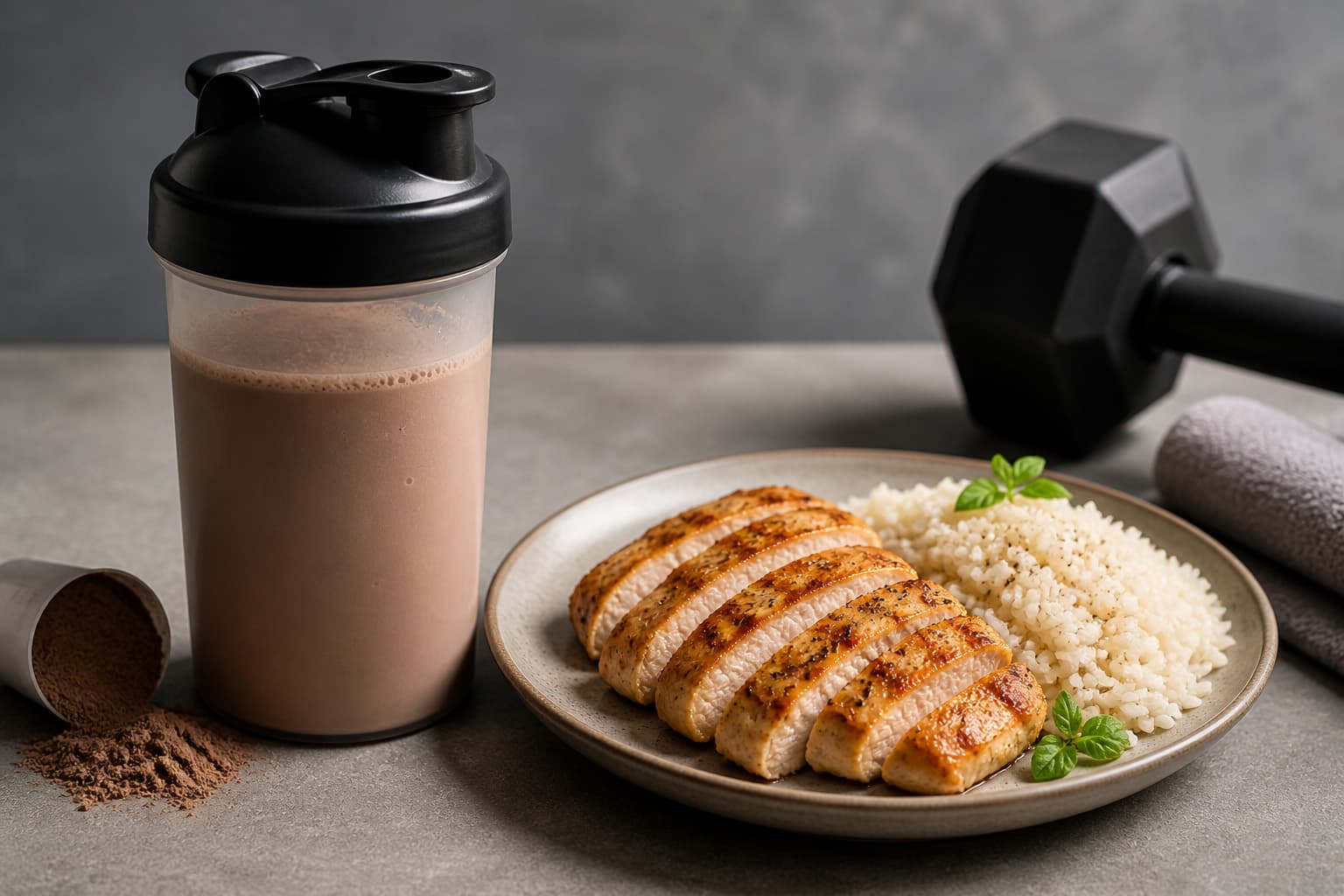
How much protein should you eat after a workout to maximize recovery?
The direct answer:
- Dose: 0.4–0.5 g per kg of body weight per session (25–40 g in most cases)
- Timing: within 2 hours of training — not necessarily within 30 minutes
- Source: whey or whole food with high biological value (Greek yogurt, chicken, eggs)
Immediate example for a 75 kg person:
- Optimal dose:
75 × 0.4 = 30 g(minimum) →75 × 0.5 = 37 g(target) - Post-workout meal: 30 g whey + 300 ml whole milk + banana → 42 g total protein ✓
Post-workout protein is not optional for people who want results — it's the biochemical signal that activates muscle protein synthesis and initiates recovery. Without this signal, the muscle damage induced by training doesn't convert into adaptation.
In this guide you'll find:
- how much protein you need per kg of body weight and by sport type
- how soon you need to eat it (the truth about the "anabolic window")
- whey vs whole food — real differences
- examples with calculated macros for different profiles
All data is based on the Nutryon engine, designed to generate personalized nutrition plans. This approach integrates ISSN guidelines and international scientific literature.
→ Calculate your daily protein with the Nutryon Macro Calculator.
How Much Protein After a Workout: Quick Answer
| Sport | Post-workout protein (g/kg) | Example 75 kg | Example 85 kg |
|---|---|---|---|
| Gym — hypertrophy | 0.4–0.5 g/kg | 30–37 g | 34–42 g |
| Endurance (running, cycling) | 0.3–0.4 g/kg | 22–30 g | 25–34 g |
| Power sports (weightlifting) | 0.4–0.5 g/kg | 30–37 g | 34–42 g |
| Combat sports | 0.4–0.5 g/kg | 30–37 g | 34–42 g |
| Team sports | 0.3–0.4 g/kg | 22–30 g | 25–34 g |
The optimal dose for muscle protein synthesis falls between 20 and 40 g per serving. Beyond 40 g the excess is oxidized — it doesn't lead to greater synthesis.
Why Post-Workout Protein Matters
Resistance training causes micro-tears in muscle fibers. This damage is the signal that activates muscular remodeling — but only if the body receives the necessary substrates.
The mechanism in 3 steps:
- Mechanical damage — muscle fibers partially break down during an intense session
- Synthesis signal — the presence of essential amino acids (particularly leucine) activates mTOR, the primary regulator of muscle protein synthesis
- Remodeling — fibers are repaired and strengthened in the 24–48 hours that follow
Without adequate post-workout protein:
- Muscle protein synthesis (MPS) remains low
- Muscle catabolism outweighs anabolism
- Recovery is prolonged, reducing the quality of the next session
In summary
- Training-induced muscle damage requires amino acids to convert into adaptation
- Leucine is the main trigger of protein synthesis — 2.5–3 g per meal for optimal activation
- Without post-workout protein, the body erodes instead of building
The Exact Dose: Formula and Calculation
Nutryon formula for post-workout protein:
Post-workout protein = body weight (kg) × 0.4–0.5 g
| Weight | Minimum dose | Target dose |
|---|---|---|
| 55 kg | 22 g | 27 g |
| 65 kg | 26 g | 32 g |
| 75 kg | 30 g | 37 g |
| 85 kg | 34 g | 42 g |
| 95 kg | 38 g | 47 g |
The 40 g threshold: research shows that beyond 40 g per single meal, muscle protein synthesis does not increase proportionally — the excess is oxidized for energy. Exception: athletes over 40 and prolonged endurance sports, where the target can rise to 45–50 g.
In summary
- Formula: weight (kg) × 0.4–0.5 g per session
- 20 g is the minimum threshold to activate MPS
- 40 g is the plateau for most individuals
- Beyond 40 g produces no additional muscle synthesis benefits
The Anabolic Window: How Much Time Do You Really Have
For years the advice was to eat within 30 minutes of training. Research has since revised this urgency.
What current literature says:
- The optimal recovery window is 2 hours, not 30 minutes
- For those who ate a full meal 2–3 hours pre-workout, the window extends to 3–4 hours
- The 30-minute urgency applies mainly to those training in a completely fasted state
Practical Nutryon rule:
| Context | Post-workout urgency |
|---|---|
| Fasted training | Eat within 30–60 min |
| Pre-workout meal 2h before | Eat within 2 hours |
| Pre-workout meal 1h before | Eat within 2–3 hours |
| Evening training (dinner) | Eat right after |
In summary
- The window is 2 hours, not 30 minutes
- Those who ate before training have more time
- Don't wait more than 2 hours — but it's not an emergency
Whey vs Whole Food: Real Differences
Both options work. The difference is in absorption speed and convenience.
| Feature | Whey protein | Whole food |
|---|---|---|
| Absorption speed | Fast (30–60 min) | Moderate (2–3 hours) |
| Leucine per 25 g protein | ~2.7 g | 1.5–2.5 g (varies) |
| Satiety | Low | High |
| Convenience | Very high | Medium |
| Cost per g protein | Medium | Low–medium |
| Best when | Right after, low appetite | Full meal, 1–2h later |
Best whole food sources post-workout:
- Greek yogurt (0%) — 100 g → 10 g protein, fast absorption
- Skyr — 200 g → 20 g protein
- Whole eggs — 3 eggs → 18 g protein
- Chicken breast — 120 g → 30 g protein
- Canned tuna — 160 g → 32 g protein
- Cottage cheese / ricotta — 200 g → 22 g protein (great in the evening: casein)
In summary
- Whey → ideal right after training, especially with low appetite
- Whole food → works equally well, requires more digestion time
- For evening: prefer casein sources (cottage cheese) for overnight muscle recovery
Real Examples with Calculated Macros
Example 1 — Runner 70 kg, morning workout
Post-workout target: 70 × 0.4 = 28 g (minimum) → 70 × 0.5 = 35 g (target)
Option A — Whey (speed): 30 g whey + 250 ml whole milk + medium banana → 390 kcal · 36 g protein · 46 g carbs · 7 g fat ✓
Option B — Greek yogurt (food-based): 300 g 0% Greek yogurt + 15 g honey + 40 g oats → 410 kcal · 34 g protein · 58 g carbs · 3 g fat ✓
Example 2 — Weightlifter 85 kg, evening workout
Post-workout target: 85 × 0.45 = 38 g (target)
Option A — Full meal: 100 g cooked white rice + 160 g chicken breast + mixed vegetables + 10 g olive oil → 580 kcal · 42 g protein · 68 g carbs · 14 g fat ✓
Option B — Snack + next day breakfast (if too late for a full meal): 250 g skyr + banana + 15 g walnuts → 420 kcal · 28 g protein · 48 g carbs · 12 g fat (adequate for late dinner)
Example 3 — Vegetarian woman 60 kg, gym 4x/week
Post-workout target: 60 × 0.45 = 27 g (target)
200 g skyr + 100 g mixed berries + 20 g hemp seeds → 360 kcal · 28 g protein · 38 g carbs · 8 g fat ✓
How It Changes Based on Your Goal
| Goal | Post-workout protein | Post-workout carbs | Notes |
|---|---|---|---|
| Hypertrophy | 35–45 g | 60–100 g | Post surplus → maximizes MPS and glycogen |
| Fat loss | 30–40 g | 30–60 g | Protein unchanged, reduce carbs |
| Athletic performance | 30–40 g | 60–100 g | Glycogen replenishment is priority |
| Maintenance | 25–35 g | 40–70 g | Balance between the two |
For the complete nutritional strategy for performance → read: Sports Nutrition: Complete Guide
What the Research Says About Post-Workout Protein
- ISSN guidelines (2017) recommend 20–40 g of high-quality protein within 2 hours of training to maximize muscle protein synthesis
- A meta-analysis by Morton et al. (2018) across 49 studies confirms that post-workout protein supplementation improves strength and hypertrophy gains compared to placebo
- Leucine is the primary amino acid that activates mTOR: at least 2.5–3 g per meal are needed for optimal activation (corresponding to ~25–30 g of complete proteins)
- Studies on athletes over 40 show the optimal MPS dose increases to 35–45 g per session compared to the 20–25 g sufficient in younger subjects
- Research on muscle protein synthesis rate shows MPS remains elevated for 24–48 hours post-workout — this explains why protein distribution across the whole day matters as much as the single post-workout meal
Frequently Asked Questions About Post-Workout Protein
Can you exceed 40 g of protein after a workout?
Yes, it's not harmful. But beyond 40 g, muscle protein synthesis doesn't increase proportionally — the excess is oxidized. Exception: sessions longer than 90 minutes and athletes over 40, where the target can rise to 45–50 g.
What happens if you skip the post-workout meal?
It's not catastrophic for a single session. The problem is the systematic habit: regularly skipping protein recovery slows long-term progress and increases the risk of muscle mass loss during calorie deficit phases.
Are eggs as good as whey after a workout?
Yes, whole eggs contain all essential amino acids with excellent bioavailability. Three eggs provide ~18 g of protein with 2.2 g leucine — adequate for MPS. Whey is faster, but eggs work perfectly for a full meal 1–2h later.
Whey concentrate or whey isolate after training?
For most people, concentrate (80% protein) is sufficient. Isolates make sense for those who are lactose intolerant or seek maximum absorption speed.
How much total daily protein if you train?
The daily total matters more than the single post-workout meal. The ISSN target for athletes is 1.6–2.4 g/kg/day. → For the full calculation: Sports Nutrition Guide.
Calculate Your Post-Workout Protein with Nutryon
Knowing the optimal dose is the first step. The second is correctly distributing protein throughout the whole day — not just in the post-workout meal.
Nutryon automatically calculates:
- your daily protein target based on your sport and goal
- the optimal distribution across meals including post-workout
- precise timing based on your actual training schedule
→ Enter your data and get a plan with protein already calibrated to your real session.
Time required: less than 2 minutes.