
Many people want to know how many calories to eat to lose weight or build muscle, but they start from the wrong point.
The first number to know is your basal metabolic rate, also called BMR.
It is the foundation of any serious nutritional calculation.
What is basal metabolic rate
Basal metabolic rate is the amount of energy your body burns at complete rest, simply to stay alive.
It powers:
- breathing
- heartbeat
- maintaining body temperature
- brain activity
- cellular functions
- vital organs
Even if you stayed in bed all day, you would still burn calories.
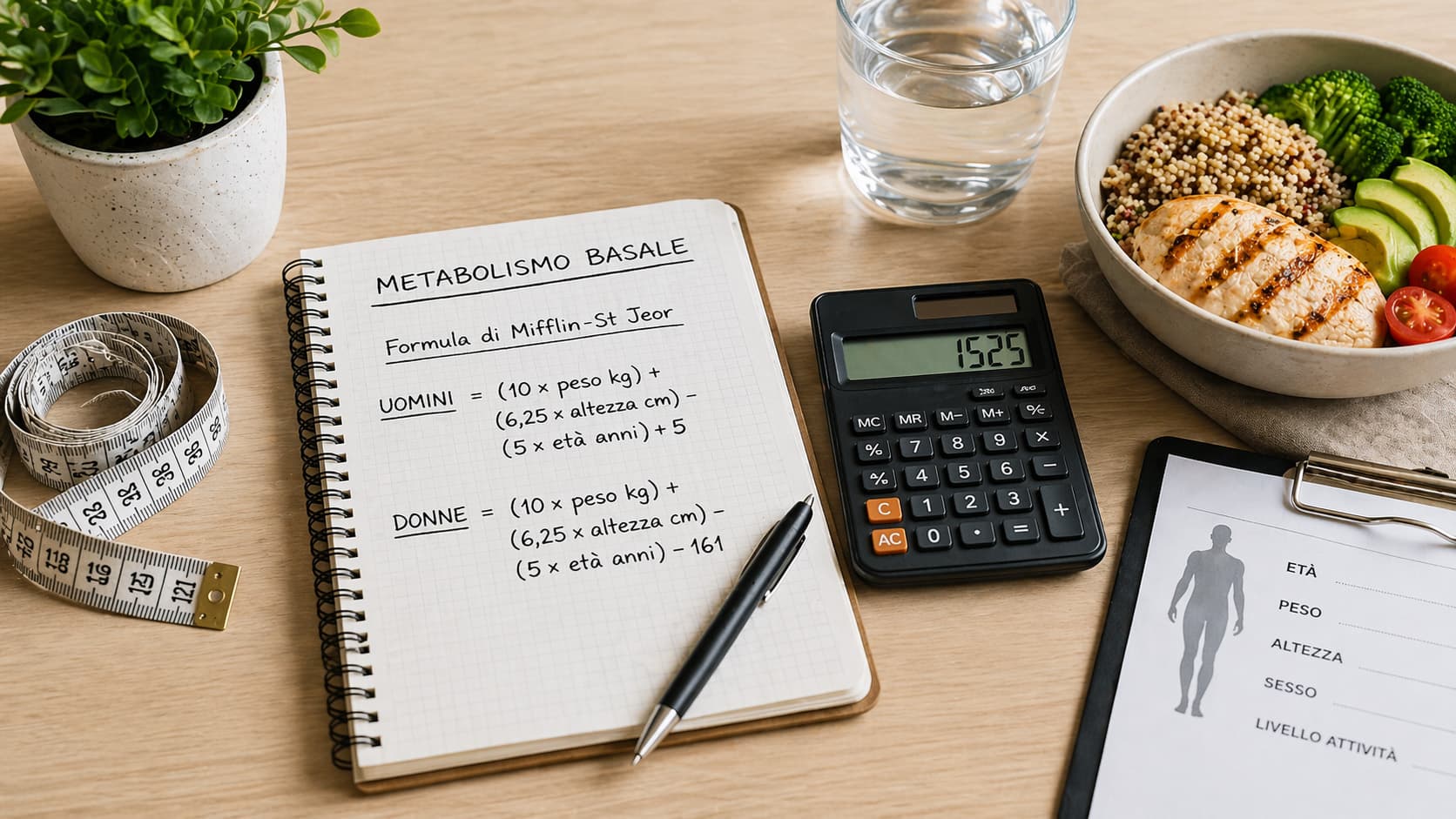
The most reliable formula: Mifflin-St Jeor
One of the most widely used and reliable formulas is Mifflin-St Jeor.
Men
BMR = (10 × weight kg) + (6.25 × height cm) − (5 × age) + 5
Women
BMR = (10 × weight kg) + (6.25 × height cm) − (5 × age) − 161
Practical example — man
Male:
- 65 kg (143 lb)
- 175 cm (5'9")
- 44 years old
Calculation:
- 10 × 65 = 650
- 6.25 × 175 = 1,093.75
- 5 × 44 = 220
Total:
650 + 1,093.75 − 220 + 5 = 1,528 kcal
Estimated basal metabolic rate: approximately 1,528 kcal
Practical example — woman
Female:
- 60 kg (132 lb)
- 165 cm (5'5")
- 35 years old
Calculation:
- 10 × 60 = 600
- 6.25 × 165 = 1,031
- 5 × 35 = 175
Total:
600 + 1,031 − 175 − 161 = 1,295 kcal
Estimated basal metabolic rate: approximately 1,295 kcal
BMR is not how much you should eat
Common mistake: thinking that basal metabolic rate equals total caloric needs.
It doesn't.
BMR is just the base.
You still need to add:
- daily steps
- physical or sedentary work
- workouts
- digestion
- spontaneous movement
This is why we use TDEE (total daily energy expenditure).
Why knowing your BMR is useful
It helps you:
Lose weight
Create a calorie deficit from your real total expenditure.
Build muscle
Create a controlled calorie surplus.
Avoid eating too little
Many diets drop below unnecessarily low levels.
Average reference values
| Profile | Average BMR | |---|---| | Small sedentary woman | 1,200–1,350 | | Active woman | 1,350–1,550 | | Average sedentary man | 1,500–1,750 | | Active man | 1,700–2,100 |
What influences basal metabolic rate
Muscle mass
More muscle = higher energy expenditure.
Age
BMR tends to decrease with age.
Height and weight
Larger bodies burn more calories.
Genetics
Individual variability exists.
Drastic dieting
Extreme cuts can reduce metabolic rate over time.
How to increase metabolism (realistically)
There are no miracles.
What actually works:
- increasing muscle mass
- consistent training
- more daily movement
- adequate sleep
- avoiding repeated extreme diets
Common myths online
"My metabolism is broken"
Usually this is caloric adaptation, not a broken metabolism.
"I eat 1,000 kcal and still gain weight"
Most often the result of inaccurate tracking or weekend compensation.
"Supplements that boost metabolism"
Minimal effect in the vast majority of cases.
When BMR isn't enough
Basal metabolic rate is a useful estimate, but it doesn't account for:
- actual daily steps
- training (gym, running, sports)
- stress
- diet adherence
- body composition
This is why a personalized plan is superior to a simple calculation.
FAQ
Does basal metabolic rate change?
Yes. It changes with weight, muscle mass, age, and lifestyle.
Will I lose weight faster if I eat below my BMR?
Not necessarily. It often worsens hunger and sustainability.
Can I know my exact BMR?
Only with specific tests. Formulas are excellent estimates.
Are BMR and TDEE the same thing?
No. TDEE includes all daily activity on top of BMR.
Conclusion
Basal metabolic rate is the correct starting point for understanding how many calories you need.
It's not the final number to eat — it's the base from which to build a smart plan for losing fat or gaining muscle.
If you want a real calculation that factors in your activity, goal, and meal distribution, Nutryon builds the plan starting from this data.