
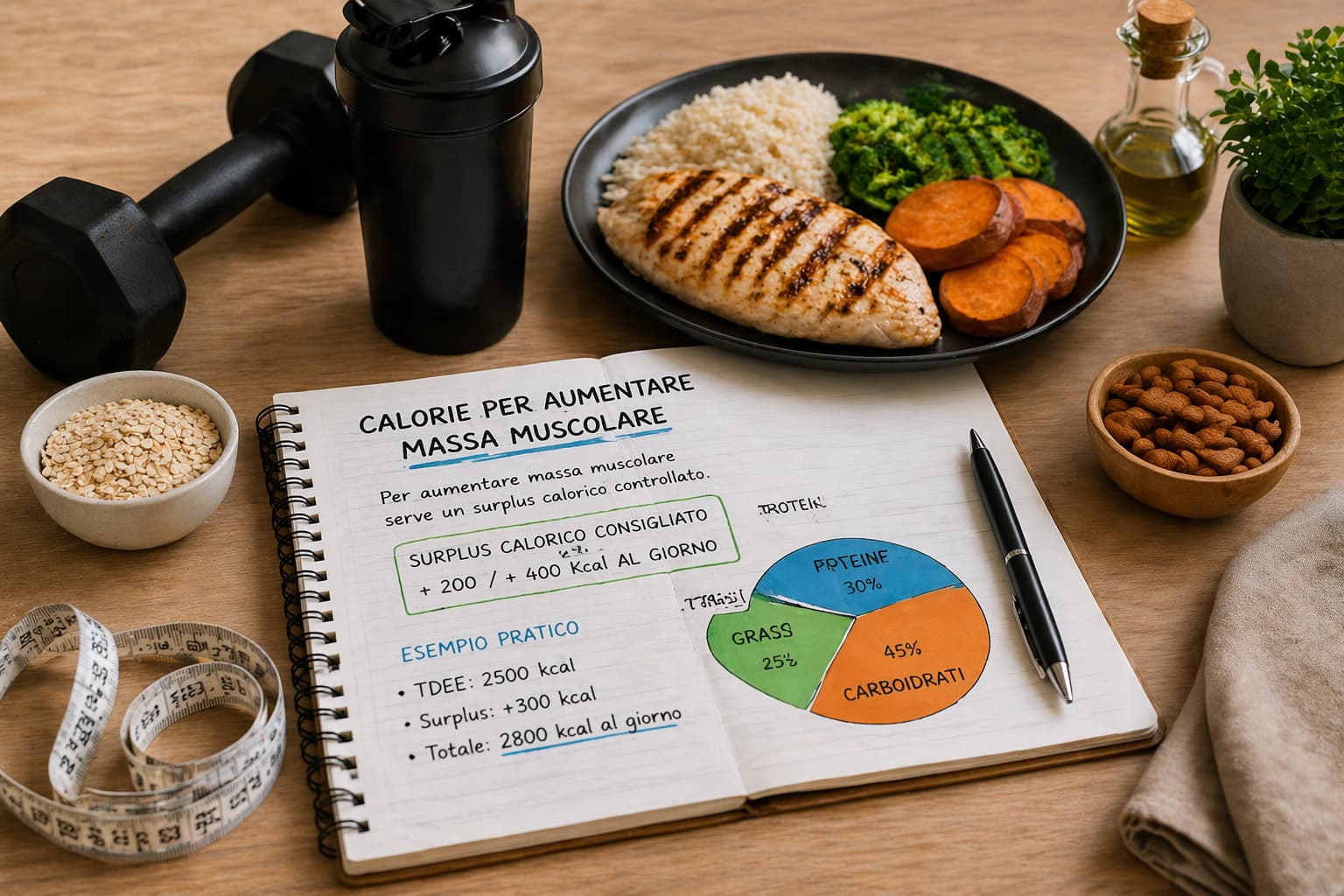
Many people think that to build muscle you just need to eat a lot.
In practice, this rarely works.
Eating too much usually leads to:
- excess body fat gain
- digestive discomfort
- poor diet quality
- unstructured bulk
To build muscle effectively you need an intelligent calorie surplus.
The short answer
To build muscle efficiently, in most cases you need:
- +150 to +250 kcal above maintenance = lean approach
- +250 to +400 kcal = faster approach
- above +500 kcal = often too aggressive
First step: know your maintenance calories
You need to know how many calories you burn to maintain your current weight.
This value is your TDEE.
Example:
Male, 65 kg (143 lb), 175 cm (5'9"), active with 2 workouts per week:
Estimated TDEE = 2,300 kcal
For muscle gain:
- lean bulk: 2,450 kcal
- standard bulk: 2,550 kcal
- aggressive: 2,700 kcal
How much muscle can you actually build
Most people overestimate the real rate of muscle growth.
As a rough guide:
Beginner
0.5–1 kg/month total weight including muscle
Intermediate
0.2–0.5 kg/month
Advanced
Slower and more progressive
Small or large surplus — which is better?
A moderate surplus wins almost every time
Because:
- less fat accumulated
- better insulin sensitivity
- better digestion
- more sustainable long-term
Ideal macronutrients for muscle gain
Protein
1.6 – 2.2 g/kg body weight
Fat
0.8 – 1 g/kg body weight
Carbohydrates
The remaining calories
Real example — 65 kg (143 lb) man
Target calories: 2,500 kcal
Possible split:
- Protein: 130 g
- Fat: 65 g
- Carbohydrates: 340 g
If you train with intense sports
Those who do BJJ, MMA, CrossFit, or other high-intensity sports often benefit from:
- higher carbohydrate intake
- nutrient timing around training
- careful hydration
- better recovery focus
How to tell if you're eating enough
Monitor for 2 weeks.
If weight isn't rising
Add 100–150 kcal.
If it's rising too fast
Reduce by 100–150 kcal.
Ideal range
+0.25% to +0.5% of body weight per week.
Common mistakes
1. Dirty bulking — "eating anything to gain mass"
This mainly just adds extra fat.
2. Too little protein
Limited muscle synthesis.
3. Insufficient progressive training
Calories without the right stimulus don't build muscle.
4. Cutting carbohydrates
Usually hurts performance and recovery.
Useful foods for building muscle
- rice
- pasta
- oats
- whole grain bread
- Greek yogurt
- skyr
- eggs
- chicken
- legumes
- extra virgin olive oil
- nuts and seeds
- fruit
Useful supplements (not mandatory)
- creatine monohydrate
- whey protein if needed
- vitamin D if deficient
- magnesium if helpful for recovery
FAQ
Can I build muscle without gaining fat?
Yes, with a moderate surplus and correct training.
Do I need 3,000 calories?
Not necessarily. It depends on your individual TDEE.
If I'm naturally lean, should I eat a huge amount?
No. Eat consistently above your maintenance — that's enough.
How long does it take?
Often months, not weeks.
Conclusion
Building muscle doesn't require eating randomly.
It requires a controlled surplus, adequate protein, useful carbohydrates, and progressive training.
Those who manage these factors well build more muscle with less fat and better long-term results.
If you want calories and macros personalized to your real metabolism, Nutryon creates the plan precisely and sustainably.