
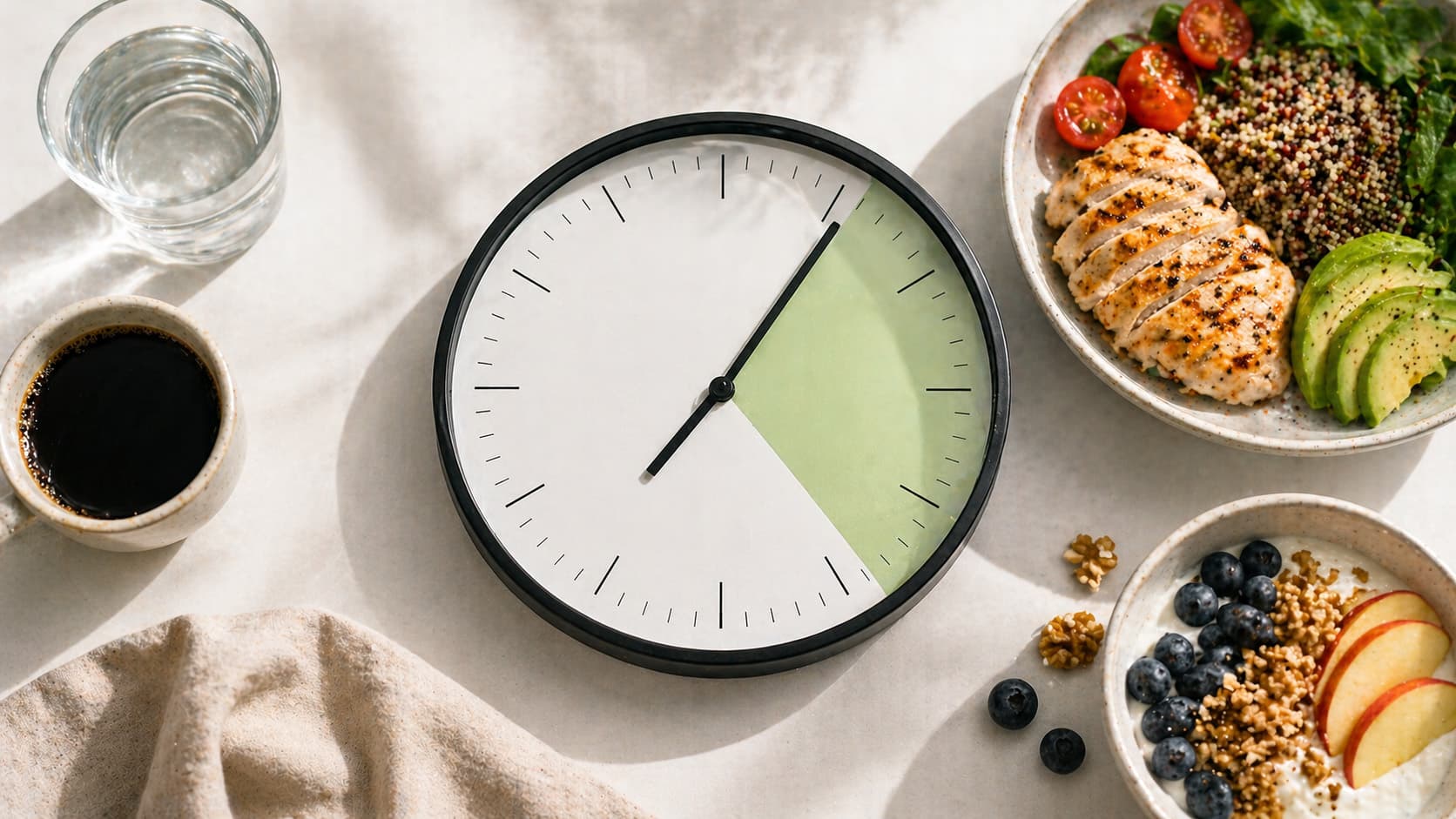
Intermittent fasting 16:8 is one of the most searched dietary methods online. For some it's revolutionary, for others a passing trend. The right question, though, isn't whether it's "magic" — it's whether it can actually help in the right context.
The short answer: it can work for fat loss, but not because it activates some inevitable special mechanism. It works primarily when it helps you control calories, build better eating habits, and stay consistent over time.
If you want to know how many calories you actually need before choosing any method, start for free with Nutryon: create your plan.
What Is Intermittent Fasting 16:8
The 16:8 protocol involves 16 hours of fasting and an 8-hour eating window within the same day.
Common examples:
- first meal at 12:00 pm → last meal at 8:00 pm
- first meal at 10:00 am → last meal at 6:00 pm
- first meal at 1:00 pm → last meal at 9:00 pm
There's no single perfect schedule. What matters most is finding a window that fits your lifestyle sustainably.
Does It Really Work for Weight Loss?
Yes — if it creates a sustainable calorie deficit.
Many people lose fat with 16:8 because they naturally:
- eliminate casual snacking outside meals
- eat less frequently throughout the day
- manage evening hunger more effectively
- simplify the structure of their day
They don't lose weight automatically "because they skip breakfast." Fat loss still depends on total energy balance — calories consumed vs. calories burned.
More detail: how to calculate your calorie deficit
Potential Benefits of 16:8
1. Greater Mental Simplicity
Fewer food decisions spread throughout the day. For many people, reducing the number of meals simplifies overall adherence.
2. Better Adherence for Those Who Hate Tracking Everything
For some people, respecting a time window is easier and more sustainable than logging every meal and macro.
3. Natural Snack Control
The protocol structurally reduces mindless eating without real hunger — one of the main saboteurs of weight loss.
4. Stable Routine
Many people find order and predictability in fixed meal times, which can improve long-term adherence.
When It Might NOT Work
1. Overeating During the Eating Window
If you eat too much in the 8 hours — even unconsciously — the deficit disappears and so does the weight loss.
2. Excessive Hunger Leading to Worse Choices
Some people arrive at their first meal so hungry that they lose control over the quality and quantity of what they eat.
3. Decline in Training Performance
This depends heavily on training schedule and meal timing. Those who train early in the morning in a fasted state often notice significant energy drops.
4. Rigidity That's Incompatible With Social Life
When the protocol becomes a rigid obsession, it rarely lasts. Flexibility is just as important an adherence factor as structure.
Intermittent Fasting and Metabolism
A common concern is that skipping meals "shuts down metabolism." In the short term, this effect is usually overstated.
What actually impacts metabolism over time:
- average weekly calorie intake
- muscle mass maintained
- total daily movement
- sleep quality
- chronic stress
The 16:8 fast, when not paired with excessive calorie restriction or inadequate protein, doesn't normally cause meaningful metabolic reduction.
More detail: slow metabolism — does it really exist?
What to Eat in the 8-Hour Window
16:8 doesn't compensate for a low-quality diet. Timing doesn't override food composition.
Real priorities within the eating window:
- adequate protein — essential for muscle preservation (1.6–2.2 g/kg)
- vegetables and fiber — for satiety and micronutrients
- carbohydrates matched to activity level
- quality fats — not to be eliminated
- correct total calories — the factor that determines the outcome
Simple Example for a 12:00 pm–8:00 pm Window
12:00 pm — Lunch Protein source + complex carbohydrates + vegetables
4:00 pm — Snack Greek yogurt, fruit, nuts, or protein-based snack
7:30 pm — Dinner Protein source + carbohydrates or vegetables
Training With 16:8
There's no single strategy. It depends on the person, preferred training time, and goals.
Training Before the First Meal (Fasted)
Easy to schedule for some, brutal for others. Those who perform well fasted can keep it. Those who notice performance drops should consider a small pre-workout meal.
Training Within the Eating Window
Often the simplest solution — eat before, train, eat after.
Evening Training With Post-Workout Dinner
Very common for those who work during the day. Dinner doubles as the recovery meal.
If performance drops significantly and persistently, adapt the protocol — not necessarily abandon it.
Intermittent Fasting and Muscle Loss
16:8 doesn't automatically cause muscle loss. The risk increases when:
- protein intake is insufficient during the eating window
- strength training is absent as a muscle-preserving stimulus
- calories are excessively low (deficit above 25% of TDEE)
With adequate protein and regular training, muscle mass holds up well even with 16:8.
Read also: protein for weight loss: complete guide
Who It Can Work Well For
- those prone to constant snacking who want to reduce it structurally
- those who dislike eating many small meals throughout the day
- those who thrive on simple routines with clear time boundaries
- those who naturally function better eating from late morning onward
- those who struggle to control calories with traditional counting methods
Who It's Often Less Ideal For
- those who experience intense morning hunger
- those with a difficult relationship with food (risk of compensatory overeating)
- those who train much worse in a fasted state
- those who follow the protocol with obsessive rigidity rather than as a flexible tool
Common Mistakes
1. Expecting Automatic Results Just From the Schedule
16:8 doesn't produce fat loss without a calorie deficit. It's a container, not a solution by itself.
2. Neglecting Protein
Common in 16:8: meals are reduced but adequate protein intake isn't maintained. The result is lean mass loss instead of fat loss.
3. Compensating With Junk Food in the Eating Window
Timing doesn't cancel out food quality. Compressing everything into 8 hours doesn't justify poor food choices.
4. Copying Influencer Protocols Without Personalization
It works when adapted to you — your schedule, training, lifestyle, and goals. There's no single universal version.
Frequently Asked Questions
Is skipping breakfast mandatory?
No. You can shift the window earlier (e.g., 8:00 am–4:00 pm) if you prefer eating breakfast. The point is the 8-hour window, not which meal you skip.
Can I drink coffee or tea during the fast?
Many people use black coffee or plain tea. They don't break the fast in any metabolically relevant way for weight loss. Individual tolerance varies.
Is 16:8 better than a traditional diet?
Not in absolute terms. It's better only if it's more sustainable for you and concretely helps you eat better and less.
How many days per week should I do it?
Most people apply it daily. Applying it 5 days out of 7, with more flexibility on weekends, is a common and valid approach.
Conclusion
Intermittent fasting 16:8 is a tool, not a shortcut.
It can work well if it helps you:
- naturally control your calorie intake
- eat better without tracking everything
- build a clear, sustainable routine
- stay consistent over time
It's not the right method if it creates excessive hunger, harmful rigidity, or loss of control within the eating window.
The best weight loss method is always the one you can genuinely follow — consistently, with real results over the long term.
If you want a plan built around your schedule, goals, and lifestyle, start for free with Nutryon: create your personalized plan.