
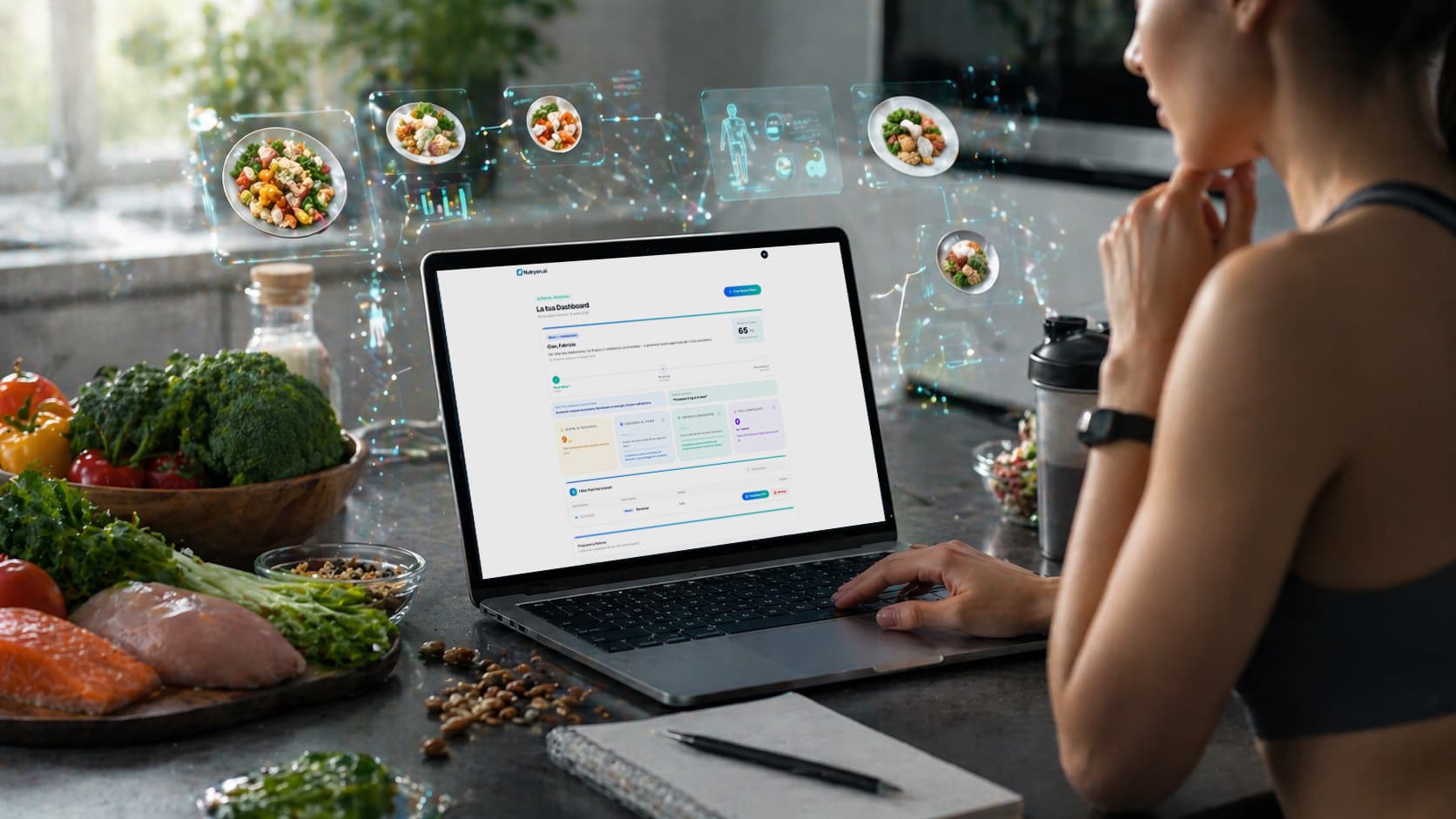
In recent years, many people have started using AI tools to ask for diets, calorie counts, meal plans, and nutrition advice. But not everything called "AI nutrition" is genuinely personalized.
A serious AI nutrition plan shouldn't just generate generic text. It should analyze real data, concrete goals, and personal constraints to build a coherent strategy.
The difference between these two approaches is enormous — in terms of results, adherence, and safety.
If you want to try it directly, you can start for free with Nutryon: create your plan.
What Is an AI Personalized Nutrition Plan
It's a meal plan built by an intelligent system that uses individual inputs to generate recommendations better suited to the specific person.
Examples of data useful for real personalization:
- age, sex, weight, height
- physical activity level and type of training
- goal (fat loss, muscle gain, maintenance, body recomposition)
- food preferences and cuisine style
- food allergies or exclusions
- work schedule and desired number of meals
- country of residence and reference nutritional guidelines
Without this data, what gets produced is mostly generic content that looks personalized — but isn't.
How a Serious System Actually Works
1. Precise Initial Data Collection
The system gathers useful, specific information — not just "I want to lose weight." The more detailed and accurate the profile, the better the final output can be.
2. Calculating Real Energy Requirements
The system estimates parameters such as:
- basal metabolic rate (BMR) using validated formulas (e.g., Mifflin-St Jeor)
- total daily energy expenditure (TDEE)
- calorie target consistent with the stated goal
More detail: TDEE: what it is and how to calculate your real daily calorie needs
3. Macronutrient Distribution
Protein, carbohydrates, and fat are adapted to the specific profile — goal, lifestyle, food preferences — not assigned with fixed percentages identical for everyone.
4. Meal Plan Construction
An advanced system should build realistic, balanced, and sustainable meals — not random menus that a real person would struggle to follow for more than a week.
5. Safety Layer and Nutritional Logic
A critical aspect that many tools overlook. A serious product includes safety checks, minimum calorie guardrails, and alignment with recognized nutritional guidelines.
Why Many AI Tools Disappoint
Because they often do just one thing: generate credible-sounding text.
Well-written text is not the same as a correct plan. Many generalist AI tools:
- ignore real calorie needs for the specific profile
- fail to handle food preferences or exclusions properly
- don't consider long-term sustainability
- produce very similar output for completely different profiles
- lack any nutritional safety logic
The result looks like a plan but is often not structured in a way that's coherent with the person's real needs.
Generic Plan vs Personalized Plan
Generic Plan
"Here's a 1,500-calorie diet."
The problem: 1,500 kcal could be too high, too low, or completely unsuitable for the specific profile. An athletic woman of 75 kg has very different needs from a sedentary woman of 58 kg — but a generic plan doesn't distinguish between them.
Real Personalized Plan
"Given your profile — age, weight, activity level, goal, and preferences — this is the calorie and macronutrient structure that's coherent for you."
The difference isn't cosmetic. It's structural — and it directly impacts adherence and results.
When an AI Plan Can Be Genuinely Useful
1. You Want to Start Quickly Without Months of Uncertainty
Many people stay stuck for a long time because they don't know where to begin. A structured plan provides a concrete starting point.
2. You Need Structure and Clarity
Knowing what to eat each day reduces decision fatigue — one of the main enemies of dietary adherence.
3. You Want Realistic, Personalized Calorie and Macro Targets
Numbers calibrated to your profile are far more useful than generic rules found online.
4. You Want a Plan Adapted to Your Real Life
Work schedules, shift patterns, cultural food preferences, training type — a good system accounts for all of this.
When AI Alone Isn't Enough
In the presence of significant clinical conditions — metabolic disorders, eating disorders, kidney conditions, pregnancy, or complex medical situations — AI alone is not sufficient.
In these cases, support from a qualified healthcare professional is necessary. AI and a nutritionist can also coexist: the AI plan as the operational foundation, the professional for clinical supervision.
What a Good AI Plan Should Have in 2026
Real Personalization Based on Individual Data
Not just name and goal, but a complete profile covering the variables that actually matter.
Specific, Realistic Objectives
Fat loss, muscle gain, body recomposition, athletic performance — with coherent numerical targets for each.
A Plan That's Sustainable in Daily Life
If a person can't follow the plan in practice, its value is zero. Sustainability is a quality criterion, not an optional feature.
Understandable Explanations
Understanding the why behind a nutritional choice significantly improves long-term adherence.
Adaptability Over Time
A plan shouldn't be static. It should evolve with results, weight changes, and the person's feedback.
Generic AI vs a Vertical Nutrition System
There's a substantial difference between asking a generalist chatbot for a diet and using a system built specifically for nutrition — with dedicated nutritional logic, validated formulas, and safety layers.
The first can produce plausible text. The second builds a coherent plan.
More detail: ChatGPT vs Nutryon for dieting: real differences between generic AI and a personalized nutrition plan
Common User Mistakes
1. Expecting the Perfect Diet From a Single Prompt
Real nutrition requires context, data, and structure. A single message cannot replace an information-gathering process.
2. Following Random Numbers Found Online
Generic calorie and macro targets aren't calibrated to your profile. They can be significantly off from your actual needs.
3. Switching Methods Every Week
Consistency is one of the most important factors for nutritional results. Jumping between approaches every few days cancels out any progression.
4. Thinking That Personalized Means Complicated
Often it's the opposite: a plan truly adapted to you is simpler to follow because it respects your real habits and actual preferences.
Frequently Asked Questions
Does AI replace a nutritionist?
Not in all cases. For healthy profiles with common goals, a well-built AI system can be highly effective. For complex clinical cases, professional supervision remains necessary.
Is it better than a standard diet downloaded online?
Yes — if the personalization is real and based on actual profile data, not just the name or generic goal.
How much does the initial input data matter?
Enormously. An AI system produces coherent output only if the inputs are accurate. Approximate or inaccurate data produces less precise plans.
Do I need to track everything forever?
Not necessarily. Many users use the structured plan in the first few weeks to understand proportions, then gain autonomy and flexibility without having to log every meal.
Conclusion
An AI personalized nutrition plan can be very useful — but only if there's a well-built system behind it, with real nutritional logic, not just the ability to generate convincing text.
To work properly, it needs:
- real, specific profile data
- structured nutritional logic
- coherent calorie and macro targets
- sustainability in daily life
- safety layers and validated guidelines
- continuous adaptation to the person
The future of nutrition isn't automated genericness. It's intelligent personalization — capable of translating individual data into concrete, followable strategies.
If you want to see how it works in practice, start for free with Nutryon: create your personalized plan.